DailyOne
pump of carbon extract into the sump
DailyObserve the tank (check for anomalies)
As neededTop
off when water level drops
As neededTrim plants when overgrown
A planted overflow tank with zero water changes, zero feeding, and zero CO₂ injection — maintained for over one year. Theory, recipe, setup guide, and real data.
📋 What You Will Learn
Let me say what you are probably thinking right now:
"You keep fish. Just do the water changes."
Fair point. But honestly? It is tedious.
Hauling buckets every week, siphoning, dechlorinating, matching temperature, slowly refilling — doing that for years on end is genuinely exhausting. With a large tank, your back will hate you too.
So I thought: "What if I engineer a system that makes water changes unnecessary?"
The answer is the system described in this article. By combining organic carbon dosing with a benthic food chain, I have maintained a planted overflow tank with zero water changes, zero feeding, and zero CO₂ injection for over one year. This is the record and theoretical framework.
I call this system the "Holobiont Aquarium," named after the biological concept of Holobiont — the idea that a host and its entire community of symbiotic microorganisms form a single superorganism.
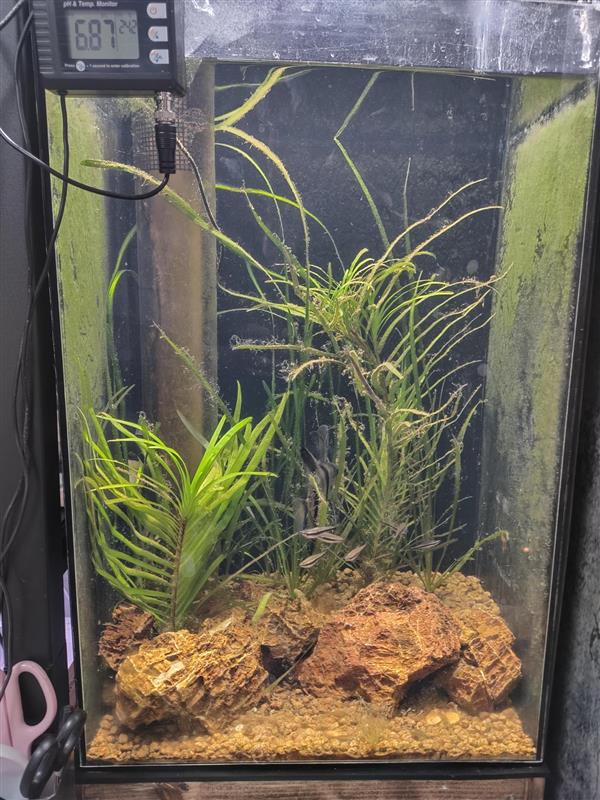
This is NOT recommended for beginners. The equipment requirements are high, and you need both the knowledge and the nerve to endure a month of cloudy water during setup.
| Approach | Mechanism | Pros | Cons |
|---|---|---|---|
| Heavily Planted Tank (ADA style) | Plants absorb nitrate and phosphate | Beautiful aesthetics | CO₂ required, trimming labor, crash risk |
| DSB (Deep Sand Bed) | Anaerobic bacteria convert nitrate to N₂ | Eliminates nitrate at source | H₂S on collapse; limited freshwater evidence |
| External Denitrification Reactor | Forced denitrification in anaerobic chambers | Easy to control | Complex setup, clogging risk, high maintenance cost |
| This System (Aerobic Carbon Assimilation) | Aerobic bacteria assimilate nitrate into biomass; benthos consume it and export it from the system | Near-zero maintenance, no CO₂, self-sustaining, no reset needed | High equipment barrier, benthos required, not for beginners |
| Comparison | Saltwater (Berlin + Vodka) | Freshwater (This System) |
|---|---|---|
| Final organic waste removal | Protein skimmer (foam export) | Benthos predation (food chain export) |
| Protein skimmer viability | Functional | Does not foam in freshwater (surface tension difference) |
| Applicable Water Type | Saltwater only | Freshwater viable |
Protein skimmers do not work in freshwater. This is the primary reason aerobic carbon assimilation was considered impossible in freshwater. This system breaks through that barrier using the benthos food chain.
The aerobic approach is fully observable and adjustable. Anaerobic approaches are black boxes — you only notice failure when it is too late.
| Situation | Observable Sign | Action |
|---|---|---|
| Sludge removal is falling behind | Sludge builds up in sump | Reduce dosing / manually siphon sludge |
| Benthos overpopulation | Sump becomes overcrowded | Let fish eat more / manually cull some |
| Oxygen deficiency | Cloudiness with foul smell | Add aeration / increase pump power |
| System in balance | Water is clear, no odor | Do nothing |
The nitrification cycle — converting ammonia to nitrite, then nitrate — occurs in every tank. The problem is what comes next. Nitrate is relatively harmless but accumulates endlessly. This system replaces the "final nitrate disposal" with carbon assimilation.
The core of this system is the "Benthos Loop" — a continuous nutrient cycle between the sump and the main tank.
This self-sustaining loop eliminates the need for water changes
| Item | Conventional Sump | This System's Sump |
|---|---|---|
| Primary Role | Decomposition (break down organics via biomedia) | Decomposition + Production |
| Biology | Bacteria-centric | Bacteria + Benthos (live food production) |
| Relationship to main tank | Auxiliary processing basin | The real heart of the ecosystem |
| Output | Purified water | Purified water + live food (benthos) |
| Filtration Type | Sludge Transport | O₂ Supply | Compatibility |
|---|---|---|---|
| Overflow | Auto-falls to sump | Sufficient via fall aeration | Only compatible ✅ |
| Canister Filter | Clogs instantly inside | Pump circulation only | Absolute NO 🚫 |
| HOB / Top Filter | Trapped by wool/media | — | Not viable |
| Under-gravel Filter | Accumulates in substrate | — | Not viable |
| Sponge / Internal | Trapped in sponge | — | Not viable |
This system's bacterial bloom demands extraordinarily high oxygen. Combined with the need to flow sludge without clogging, overflow is the only viable option.
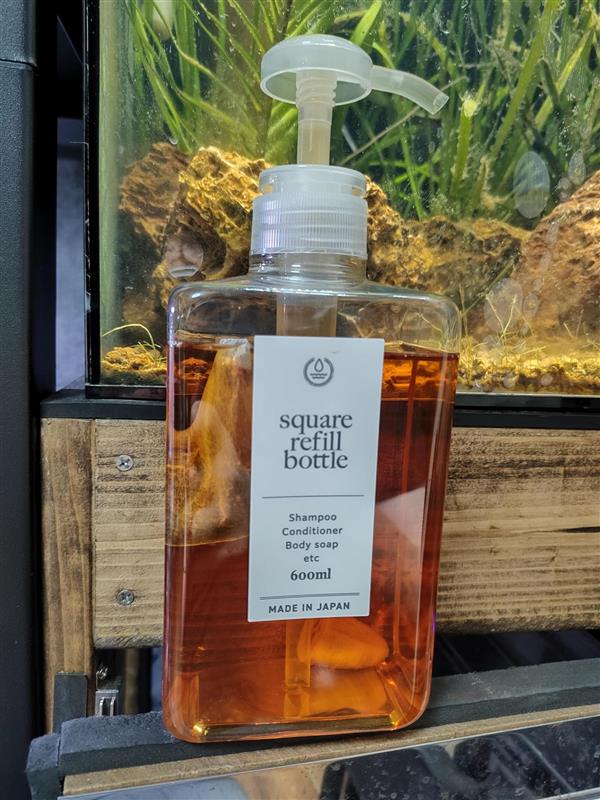
Three different carbon sources prevent monoculture and maintain a diverse bacterial community.
Dose one pump-squirt into the sump daily. Can be fully automated with a dosing pump. Store at room temperature — the vodka acts as a preservative.
In a typical no-water-change tank, acidification from nitrate accumulation is inevitable. In this system, nitrate is removed via carbon assimilation, so pH self-stabilizes. Paradoxically, pH is MORE stable without water changes than with them.
| Item | Details |
|---|---|
| Tank Size | 40×60×30cm (tall, custom-built) |
| Sump | 30cm high-type |
| Lighting | Brim Panel A (plant light) |
| Temperature | 25-26°C (heater controlled) |
| Duration | Approx. 1 year |
| Water Changes | None (top-off only) |
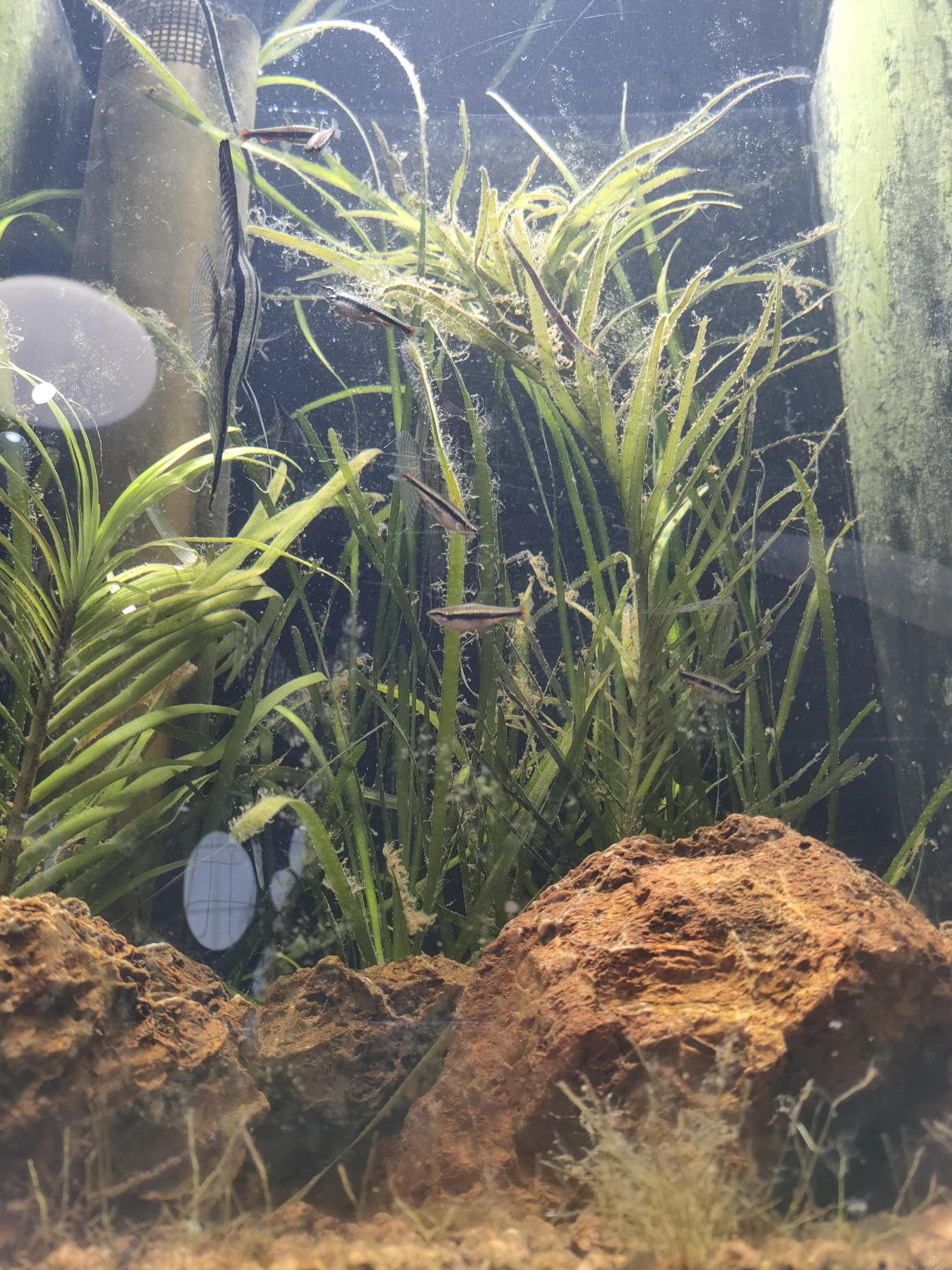
| Species | Qty | Role |
|---|---|---|
| Angelfish | 3 | Apex predator |
| Nannostomus beckfordi | 7 | Mid-Upper |
| Ring Loach | 1 | Bottom |
| Hong Kong Pleco | 2 | Bottom / Algae eater |
| Dwarf Puffer | 1 | Mid / Snail control |
| African Dwarf Frog | 3 | Bottom-Mid |
| Neocaridina shrimp | Many | Bottom / Cleanup |
| Ramshorn Snail | Many | Bottom / Decomposers |
Maintenance effectively converges to "one pump and just watching."
| Item | Cost | Where to Buy |
|---|---|---|
| Overflow Tank | Expensive (biggest barrier) | Aquarium shops / online |
| Baked Akadama | Cheap | Garden center |
| Vodka, Vinegar, Sugar | Cheap | Grocery store |
| Seaweed Salt / Banana / Rooibos Tea | Cheap | Grocery store |
| Benthos | Cheap to free | Bait shops / wild collection (availability is the challenge) |
If you can afford the overflow tank, running costs are near zero.
Water changes on large tanks are backbreaking. Maintaining 100L+ tanks can be burdensome enough to make hobbyists quit. This system eliminates that entirely.
More water = greater buffering, less fluctuation. Bacteria and benthos have more habitat, making the system more stable. In conventional management, "bigger = harder." This system inverts that relationship.
The origin of this system was a 2ch (Japanese forum) thread about "sugar-dosed tanks." Reading failure reports — "it gets cloudy," "oxygen crashes," "dangerous" — I asked the opposite question:
"Why does it fail? How can it be structurally engineered to succeed?"
Holobiont — viewing the host and its symbiotic microbiome as a single superorganism — was a concept I discovered after building this system, but it perfectly captures the design philosophy. The tank is not a container for keeping fish; it is a single living organism where fish, bacteria, benthos, and plants perpetually support each other.
One more thing: I have no talent for beautiful aquascape layouts. That is why the only plants in this setup are Azurea and Vallisneria. However, I believe this system could be adapted for ADA-style planted tanks as well. If anyone tries it, I would love to hear the results.
pH 6.85 | No water changes | No feeding | No CO₂
And the tank quietly runs on its own, as it does every day.
Author: ~3 years in aquaristics / water-change abolitionist
ver.11
/ March 2026
This work is released under CC BY 4.0. Free to share, adapt, and cite with attribution.